

Breeding
How to breed in Palworld: the complete guide
Checked by the Palworld Breeding Calculator team · last verified 2026-08-05Numbers pulled from the game's own 1.0 data files, then tested in game. How we check
8 min readUpdated 2026-08-05
Short answer
To breed in Palworld, build a Breeding Farm, place a Cake in its feed box, then assign one male and one female Pal to the farm. They produce an egg on their own; put the egg in an Egg Incubator and wait for it to hatch. The child is decided by averaging both parents' hidden breeding ranks, unless the pair matches one of the game's unique recipes.
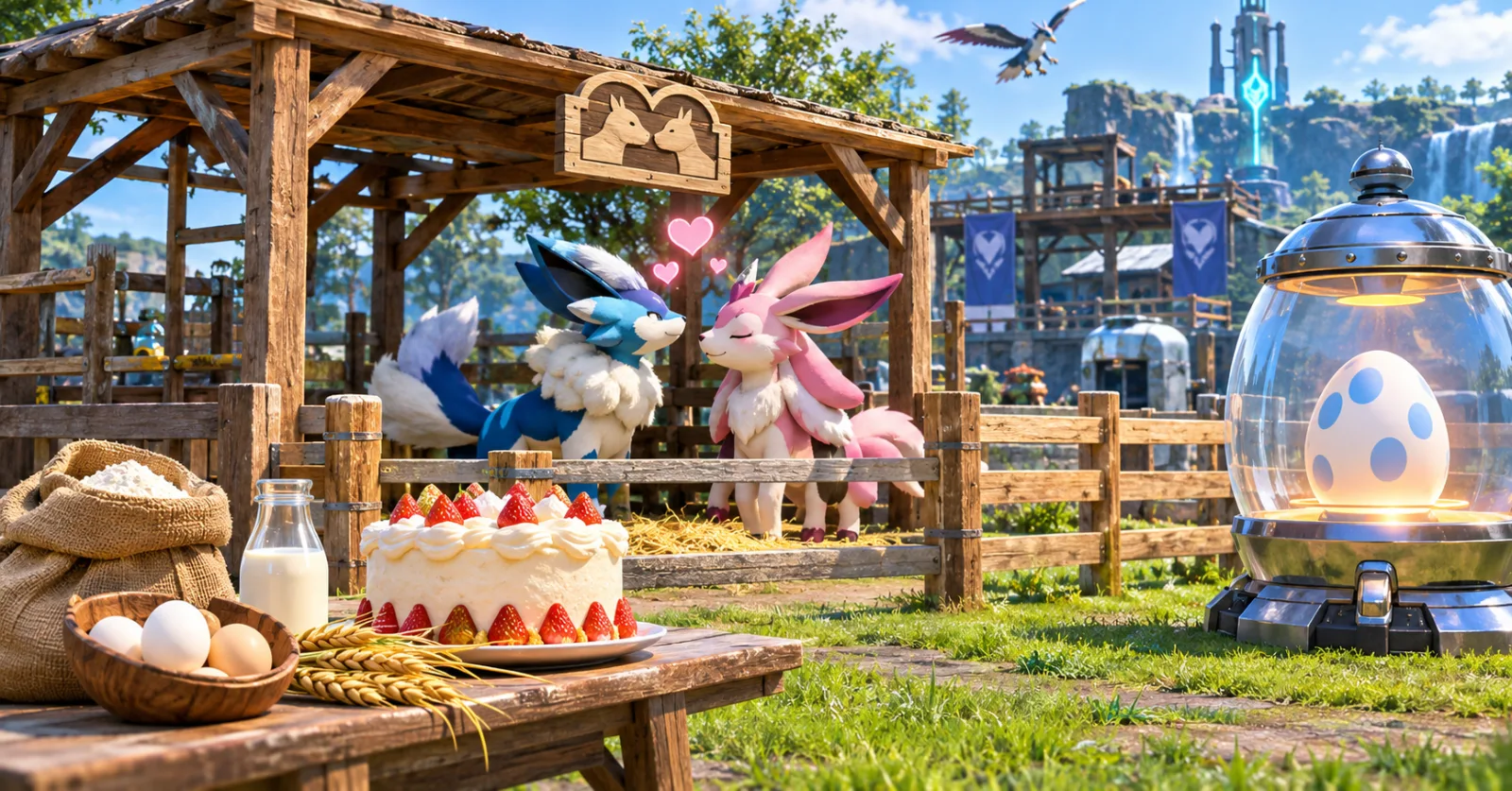
Breeding is the single most powerful system in Palworld. It is how you turn two ordinary Pals into a rare one, how you move perfect passive skills onto a mount you actually want to ride, and how you skip forty levels of grinding for a Pal that would otherwise sit behind a boss fight. It is also the system most players set up slightly wrong and then quietly give up on.
This guide covers the whole loop from the first Breeding Farm to a hatched, passive-stacked child, and it explains the actual maths the game runs when it decides what comes out of the egg. Every combination mentioned here can be checked live in the Palworld breeding calculator on this site.
What you need before you can breed
Breeding unlocks at Technology level 19, which is where the Breeding Farm blueprint appears in your tech tree. You need three things in place:
- A Breeding Farm. Costs 100 Wood, 20 Stone and 50 Fiber. It is a large structure, so place it on flat ground with clearance on all sides — Pals will refuse to path into a farm wedged between walls.
- A Cake. This is the real bottleneck. One Cake is consumed per egg.
- One male and one female Pal. Gender is shown next to the Pal's name in the Palbox. Two males or two females will stand in the farm forever and produce nothing.
Cake takes 5 Flour, 8 Red Berries, 7 Milk, 8 Eggs and 2 Honey, and it is made at a Cooking Pot. Flour comes from Wheat ground in a Mill, Milk from Mozzarina, Eggs from Chikipi, and Honey from Beegarde or Cinnamoth. Almost everyone's breeding stalls on Cake, not on the Pals.
Build a Cake supply chain before you build the farm
The players who breed comfortably are the ones who set up a small food base first. A practical minimum:
- A Wheat Plantation plus a Mill, with a Pal that has Planting, Watering and Gathering assigned
- Two or three Mozzarina in a Ranch for Milk
- Four to six Chikipi in the same Ranch for Eggs
- Two Beegarde or a couple of Cinnamoth for Honey
- A Berry Plantation for Red Berries
- A Pal with high Kindling to run the Cooking Pot
Once that base loops on its own, you can leave the game running and come back to a chest full of Cake. Without it you will hand-craft one Cake per egg and stop bothering after three.
Step by step: your first egg
- Place the Breeding Farm at a base with a free Pal slot for workers.
- Open the farm's feed box and drop in a Cake (you can stack several — one is eaten per egg).
- Open your Palbox, pick a male Pal, and choose Assign to Breeding Farm. Do the same for a female.
- Wait. The pair will walk around the farm, then a Huge Egg appears on the ground with a small icon above it.
- Pick the egg up, walk it to an Egg Incubator, and place it inside.
- Adjust the temperature if the incubator warns you, then wait for the hatch timer.
Egg production takes roughly 5 real-world minutes of active in-game time per egg with a Cake available. It does not progress while the base is unloaded on a server you are not near, so breeding runs fastest when you stay at or near the breeding base.
How Palworld decides which Pal hatches
This is the part almost every guide gets vague about. Palworld does not use elements, levels or rarity to decide the child. Every Pal has a hidden number in the game files called its combi rank (breeding rank). The game averages the two parents' ranks and picks the Pal whose rank sits closest to that average.
The exact formula is:
child rank target = floor((parent A rank + parent B rank + 1) / 2)
The game then walks the full list of breedable Pals and returns whichever one has the smallest distance between its own rank and that target. Ties resolve toward the Pal that appears earlier in the internal ordering, which is why some pairs produce a result that looks arbitrary until you see the numbers.
A few consequences worth internalising:
- Two low-rank parents can never produce a high-rank Pal. An average always sits between the two inputs, so you climb the ladder in steps.
- Pairing a very high-rank Pal with a very low-rank Pal lands you in the middle, which is how most mid-tier Pals get bred.
- The child is not random. Given the same two parents you get the same species every single time. Only passives and gender vary.
The breeding calculator on this site runs that exact formula against the extracted v1.0 rank table, and the combinations page reverses it: pick the Pal you want and it lists every parent pair in the game that produces it.
Unique recipes: the exceptions that ignore the formula
Palworld hard-codes 251 special pairs that bypass rank averaging entirely. If a pair matches one of these, the recipe wins and the formula is never consulted. These are the only way to obtain most regional variants.
| Child | Parent A | Parent B |
|---|---|---|
| Mossanda Lux | Mossanda | Grizzbolt |
| Relaxaurus Lux | Relaxaurus | Sparkit |
| Blazehowl Noct | Blazehowl | Felbat |
| Incineram Noct | Incineram | Maraith |
| Vanwyrm Cryst | Vanwyrm | Foxcicle |
| Azurobe Cryst | Azurobe | Frostplume |
| Kingpaca Cryst | Kingpaca | Reindrix |
| Suzaku Aqua | Suzaku | Jormuntide |
Any pair flagged Unique in the calculator is one of these. If you are hunting a specific rare Pal, always check the combinations page first — a unique recipe is usually far cheaper than climbing there through averages.
Pals you cannot breed at all
Thirty-nine Pals have no breeding rank in the game data, which means no pair of parents will ever produce them. That list includes the Alpha-only legendaries and the raid bosses:
- Jetragon, Frostallion, Frostallion Noct, Paladius, Necromus — tower and field legendaries
- Bellanoir and Bellanoir Libero, Xenolord, Blazamut Ryu — raid and Feybreak bosses
- Grizzbolt, Lyleen Noct, Orserk, Faleris, Shadowbeak, Selyne as *tower boss* variants — note that the normal versions of several of these are breedable through unique recipes
- Every collaboration Pal
If the calculator tells you a Pal has no combinations, that is not a data gap — it genuinely has to be caught or defeated. See the legendary breeding guide for what you can and cannot shortcut.
Passive skills: the real reason to breed
Species is only half the point. The other half is passive skill inheritance, and this is where serious players spend their Cake.
How inheritance works in practice:
- The child draws from the combined pool of both parents' passives.
- It can inherit between 0 and 4 passives, and it can also roll a random new passive that neither parent had.
- A passive that both parents share is much more likely to carry over than one only a single parent has.
- Traits are inherited independently of species, so you can move a perfect passive set down a whole breeding chain.
The four passives most players chase for combat Pals are:
| Passive | Effect |
|---|---|
| Legend | Large Attack and Defense boost (legendary Pals only) |
| Musclehead | +30% Attack, -50% Work Speed |
| Ferocious | +20% Attack |
| Burly Body | +20% Defense |
For work Pals the target set is different — Serious, Artisan, Lucky and Work Slave stack into a base worker that outproduces three ordinary Pals.
The condensing loop
The standard method for building a perfect Pal:
- Catch or breed several copies of the species and note their passives.
- Pair the two with the best partial sets. Hatch, check the child, and discard the misses.
- Repeat, always breeding the current best child back into a partner holding the missing passive.
- Once you have a 4-passive result, use Pal Condenser copies to raise its star rank.
Expect this to take a dozen or more eggs. Keep a chest of Cake near the farm so the loop never stops for supplies.
Breeding a Pal you do not have parents for
Sometimes the pair you need uses a Pal you have never caught. Rather than hunting it, work backwards: the breeding path finder takes the Pals you already own and searches for the shortest chain of breeding steps to your target, one generation at a time. It is usually faster to hatch two intermediate Pals than to fly across the map hunting a rare spawn — and if you do need to hunt, the interactive map marks every Alpha Pal and field boss location.
Common breeding mistakes
- Same-gender pair. Nothing happens and no error is shown. Check the gender icon in the Palbox.
- Empty feed box. No Cake means no egg. The farm gives no warning.
- Base out of range. On dedicated servers, unloaded bases do not tick. Stay nearby or use the base as your main hub.
- Full Palbox. Hatching fails silently when you have no space. Clear slots before a hatching session.
- Assuming elements matter. They do not. A Fire Pal plus a Water Pal is not "super effective" — only ranks and unique recipes count.
- Breeding your only copy away. Assigning a Pal to a farm does not consume it, but condensing does. Keep your best worker out of the Condenser.
Quick reference
| Question | Answer |
|---|---|
| Tech level to unlock | 19 |
| Farm cost | 100 Wood, 20 Stone, 50 Fiber |
| Food required | 1 Cake per egg |
| Time per egg | ~5 minutes of active play |
| Pals per farm | 1 male + 1 female |
| Breedable Pals | 260 of 299 |
| Unique recipes | ~150 |
| Total verified pairs | 33,930 |
Once your farm loop is running, keep the calculator open on a second screen: enter the two Pals standing in your farm and it tells you what the egg will be before you spend the Cake.
Frequently asked questions
- How long does breeding take in Palworld?
- About five minutes of active in-game time per egg when a Cake is in the feed box, plus the incubation timer once the egg is in an Egg Incubator. Egg production pauses when the base is unloaded, so stay near your breeding base.
- Do you need Cake to breed in Palworld?
- Yes. The Breeding Farm consumes one Cake per egg and produces nothing without it. Cake needs 5 Flour, 8 Red Berries, 7 Milk, 8 Eggs and 2 Honey, cooked at a Cooking Pot.
- Does element or level affect what Pal you breed?
- No. Palworld averages a hidden breeding rank for each parent using floor((rankA + rankB + 1) / 2) and returns the Pal closest to that value, unless the pair matches one of roughly 150 hard-coded unique recipes. Level, element and rarity are ignored.
- Can two of the same Pal breed?
- Yes, as long as one is male and one is female. Same-species pairs always produce that same species, which makes them the standard way to concentrate passive skills.
- Which Pals cannot be bred in Palworld?
- Thirty-nine Pals have no breeding rank, including Jetragon, Frostallion, Frostallion Noct, Paladius, Necromus, the Bellanoir and Xenolord raid bosses, and every collaboration Pal. They must be caught or defeated instead.